
Why is there a choice and which one is for me?
What is the Anterior Cruciate Ligament?
Every year over 200,000 athletes, professional and unprofessional injure the Anterior Cruciate Ligament (ACL) in their knee. It is a common injury that is not so well understood and upon being told that you have torn or ruptured ligament or cartilage you may not be entirely clear what this actually means.
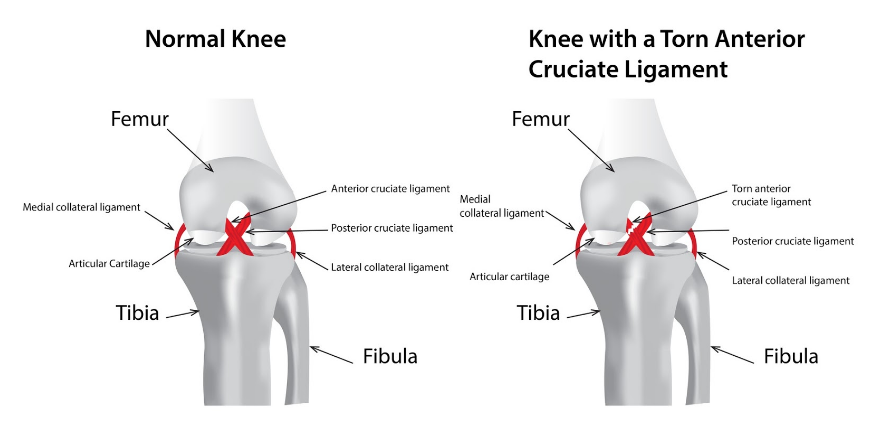
The knee is the largest and most complex joint in the human body and what happens and where can be very difficult to understand. Inside your knee your femur (thighbone) meets your tibia (shinbone) and in front of these sits the patella (knee cap) providing protection. These are held together by the anterior and posterior cruciate ligaments and the lateral and medial collateral ligaments along with cartilage.
The collateral ligaments are on the right and left side of your knee, as seen below in red, and are in control of the sideways movement of your knee. The cruciate ligaments are more centrally located and form an X, the anterior at the front and the posterior at the back, also seen below in red. They provide forward and backward motion as well as rotational movement.
Why are ACL Injuries so Common?
Anterior Cruciate Ligament (ACL) injuries are the most common knee injuries worldwide. This is because the ACL is a small ligament that runs diagonally through the knee which often takes immense pressure, particularly in competitive contact sports. The majority of ACL injuries occur through sudden stopping and pivoting and it is an injury that therefore occurs frequently in football, basketball, soccer, rugby and skiing, putting professional athletes out of action for months and sometimes years.
What Is the ACL Tear Procedure and Why Is There a Choice?
The procedure following a tear to the ACL is dictated largely by the person you are and lifestyle you lead. This is a particular reason that doctors and physios do not necessarily have one definitive path to take. Sometimes it can be annoying not being provided with a clear answer, but the procedure requires careful consideration and the choice must be the right one for you.
Following a tear, your leg will be put into a brace until the swelling has gone down and you will then start a rehabilitation process. Those who are involved in competitive agility-based sports and wish to continue being so post injury, will require an operation to make a full recovery. Those who lead a quieter lifestyle, however, do not necessarily need surgery. The knee can be recovered to more or less the same strength and flexibility through physiotherapy alone for everyday purposes like walking or running.
Surgery on the ACL
Usually, it is not possible to simply stitch the ACL back together and so the process is not so straightforward. The ligament must be reconstructed. A doctor will replace the torn ligament by inserting a tissue graft which acts as a scaffolding for a new ligament to grow. This tissue is taken from elsewhere in the body, usually from tendons in the leg. Extensive physiotherapy is required both before and after surgery to get the knee muscles up to strength and provide support around the knee whilst it recovers. Because this procedure requires the reconstruction and regrowth of the ligament, the recovery time is usually six months or more.
Can I Just Have Physical Therapy?
The advantages of choosing physical therapy over surgery are less hospital time and a quicker recovery time. As noted above, ACL surgery means taking tendons from another part of the body, leaving two or more spots to heal instead of just one.
The ACL is an important part of the knee, but the fact that you are not hopeless without it is a big deciding factor for many people. Without surgery, the anterior cruciate ligament will not heal, but the knee can become almost as strong and flexible as before with physical therapy that concentrates on restoring complete motion to the knee and strengthening the supporting leg muscles. You can still walk or run and do nearly all you can with the right physiotherapy.
The most important thing to consider is that the physiotherapy is essential. You will not find anybody who knows about Anterior Cruciate Ligament tears that denies the importance of physical therapy. You can recover perfectly well with physical therapy alone but cannot recover with the operation alone. It is of utmost importance to maintain a routine of regular knee exercises as advised by your physical therapist, whether you opt to have your ligament re-grafted or not.
If you would like extra tips and advice on knee problems check out our free book. Alternatively, if you’ve suffered a knee injury or think you may have an ongoing problem call Permar Physical Therapy directly on (928) 589-1172 to start an analysis and recovery as soon as possible, or email at [email protected].est in their exercise resolutions around the third week of January. If you’re worried you might become one of those people, you’re in the right place. We’ve got 4 tips to help you stay on track when January’s fitness-related goals begin to lose their appeal.
Switch Up Your Routine
January started off great: You woke up early each day to visit the gym, or you used your lunch break to stroll around town. You set a schedule and stuck with it, but after a couple weeks, you started to dread your daily workouts.
Sound familiar? Then it’s time for a change. Some people find comfort in doing the same thing day after day, but many folks crave variety. If you usually go for a run, try swimming or biking instead. If you like walking outside, head to a park or riverfront for a change of scenery.
Create a Home Gym
Depending on where you live, January may bring bitter cold, heavy snow, or freezing rain. If you find it difficult to leave the house during the winter, bring the gym to your home. You don’t need fancy equipment; you can get in shape with things you already have around the home.
Here are some ideas to help you tackle fitness goals at home:
- Use canned goods as weights
- Hop over phone books
- March up and down the stairs
- Watch fitness videos on TV or YouTube
- Do exercises, such as stomach crunches or jumping jacks, that don’t require equipment
- Work Out With a Friend or Pet
If you’re an introvert or a stay-at-home parent who needs an escape from running the household, you may welcome time alone during your workouts. If not, you may find that you become bored, restless, or even lonely as you strive to achieve your fitness goals. Luckily, you don’t have to get in shape alone. In fact, you’re less likely to bail on workouts if you exercise with a friend, and you might even push yourself harder.
If you don’t have any fitness-minded friends or family members, consider working with a personal trainer or asking your gym if they connect gym members with workout buddies. You can also search for a local running group via the Road Runners Club of America or connect with faraway friends via apps like Map My Walk. Joining an adult volleyball or kickball league or participating in group exercise classes at a local gym are other fun options.
Pets are a great option when it comes to exercise. Walking your dog around the park or taking a run will give you some exercise and your pet will enjoy it as much as you.
Track Results
In a world where you can connect with friends instantly via text and have online items delivered within hours via Amazon Prime, it’s easy to become discouraged when fitness progress is slow. However, just because you don’t see what’s happening yet doesn’t mean that changes aren’t occurring. Weigh yourself several times a week, preferably daily, so you can see how your workouts are benefitting your body. A recent weight loss study found that people who underwent daily weigh-ins maintained a lower weight than individuals who weighed themselves less often.
If you aren’t a fan of tracking body weight, keep a daily log that details your post-workout feelings instead. Do your clothes fit comfortably? Are you in a good mood? Have cravings for junk food subsided? You can also measure your legs, thighs, and waist to see how your body’s shape changes over time.
You might occasionally have days when you don’t feel like hitting the gym or pounding the pavement outside, and that’s okay. Make sure those days don’t turn into weeks – or even months – by utilizing the helpful tips above.